

January 21, 2015
by Bikeyface
Road Demons
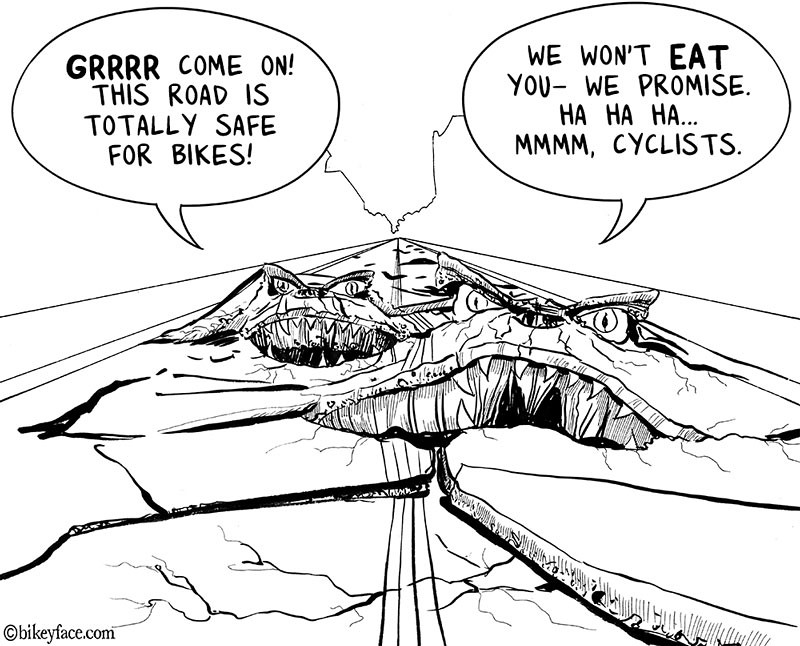
Pothole season is in full swing here.

Drivers are concerned about potholes because of potential damage to their cars. But I see potholes differently.
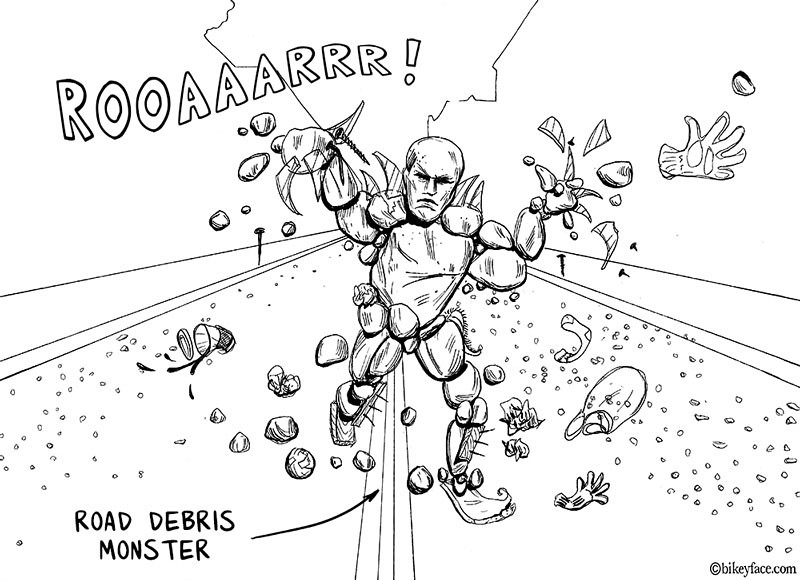
Gravel or road debris may not even register with drivers except for the outside chance of a cracked windshield. But all I see is:
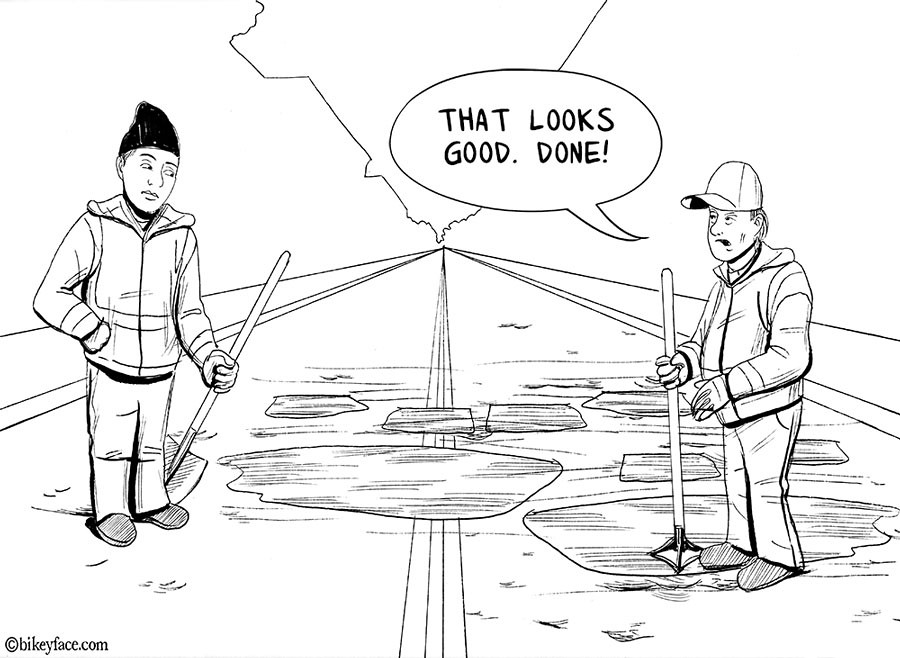
Sometimes I report issues to the city.

And they are generally quick to close the case.
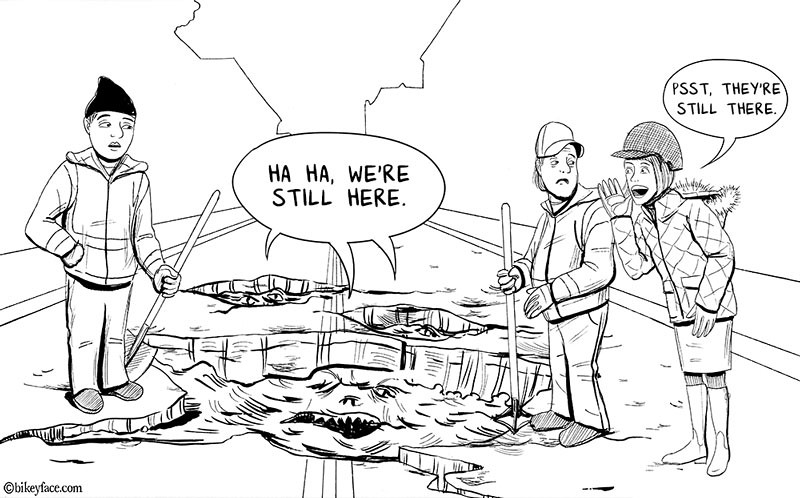
But sometimes I still hear the demons taunting me…


I commuted on a full-suspension MTB with road slicks for over a year because the potholes and broken pavement were so bad on my commute, so I really feel for you on this one
In Chicago, it takes them forever to clean the streets (I think they only do it once a month, not every week like where I live). Watch out for glass! No, really, there’s like tons of glass in the bike lanes next to the curb.
And they took out the ‘protective bollards’ in the bike lane so they could more easily clear it of snow and debris during the winter. Yeah, someone with a brain FINALLY figured out their plows didn’t fit the bike lanes! (The bollards didn’t impede the cars at all, though. They drove around them, INTO the bike lane, all the time). Cars and plows also routinely took out all the bollards (rammed them/destroyed the posts). Oops! Silly transpo planners, not realizing the consequences of their actions. But how could they? They’re only paid, like, a lot of money. And they have brains, but how to make them work? Oh, the difficulties of modern life!
Those bollard things are supposed to be re-installed in the spring, but I bet they’re never coming back.
Meh, you just need fatter tires at lower air pressure.
Fatter tires at lower pressure won’t save you from the potholes. They’ll just make you work harder at pedaling. Suspension may help smooth things out, but then again, whenever I ride a suspended bike, I feel like I’m riding a marshmallow. It seems like most of my effort is lost rather than used to move the bike. Instead, I ride my normal, everyday bike (fitted with studded tires for winter), at normal pressure, but with bright lights so as to avoid the potholes. My legs become my suspension when I can’t avoid them.
@morlamweb – if you don’t measure, you don’t actually know, you just believe what you heard from someone else (and your belief may well influence your perception of pedaling effort. Or else you’ve only been trying crappy fat tires).
For good tires and an equal diameter-pressure product (60mm x 60psi = 30mm x 120psi) I measured fat tires to have lower rolling resistance. I have never done the comparison at modestly lower pressures (e.g., 55psi, 50psi, 45psi), so I would not confidently assert that lower pressures guarantee higher rolling resistance. I was myself wrong about fat vs thin, perhaps I (and you too) are also wrong about minor adjustments to tire pressure.
Details here, including link video of measurement (when was the last time any researcher gave you a video of their experiment, eh?) https://dr2chase.wordpress.com/2007/08/27/big-vs-little-tire-resistance-test/
Seeing where you’re going works till you’re playing puddle roulette.
Boo potholes and debris!! You are right, they are more of a hazard to us than motor vehicles and they don’t just affect air quality and insurance.
@dr2chase: I don’t know about thin vs fat tires and pedaling effort. I do know that fat tires usually means knobby, wide, mountain-bike-style tires, and the rough surface of the tires (vs. the smooth surface of my summer tires) DOES increase my pedaling effort. As far as underinflated tires: I wouldn’t recommend running tires like that at all, if only to reduce the risk of punctures. I HAVE pedaled on lower-pressure tires (same bike, same person, same tires, but at ~40 PSI vs. the tires’ claimed max 65 PSI) and there was a huge difference. That’s what I referred to in my comment, not fat vs. thin tires. Would the lower-pressure tire cushion some of the bumps of the road? maybe, but at the cost of pedaling effort and increased risk of punctures.
Re: “puddle roulette”: the one major accident that I’ve had while cycling was when I hit a large pothole going downhill around 25 MPH and flew over the handlebars. I was saved mostly by my helmet. Ended up with some broken bones and stitches. The reason that I crashed is because it was dark and I had only a pathetic little light for a headlight. Ever since I upgraded to an 800-lumen headlight, I can see these potholes coming way in advance, and I haven’t had a repeat (knocks on wood).
You’re comparing crappy tires to good tires. Good tires (Schwalbe Big Apple) I measured to have lower rolling resistance at the same diameter-pressure product (that is the point of equal tire-wall tension as well). *I have heard* that other people measured fat tires (I think these were Grand Bois Hetres, at CompassCycle.com) at less than rated pressure and found that the resistance was “the same” for modestly lower pressures (I would assume that “the same” means either not enough difference to care, or else actually lower because of something related to road surfaces being less than perfectly flat). Big tires buy you a nice bit of safety — they don’t fit in sewer grates or road slots, and they’re less vulnerable (though not in vulnerable) to trolley tracks and RR tracks. You’re also perfectly free to dodge these obstacles even with big tires, but I am a big fan of defense in depth and don’t mind having a plan B.
I’ve had two notable pothole non-accidents, both with fat tires, both with suspension fork (I don’t have a suspension fork right now). One of them I should have remembered was there, but I was paying more attention to the back end of the car in front of me, hit it at 30mph, bottomed the shocks with a bang and smacked my hands, with no damage to the bike. Didn’t even stop. The other was hidden in a puddle in traffic so I had limited room to swerve, and the front fork was smacked hard enough to crack the fender into two pieces at the attachment. Only stopped to untangle the fender pieces.
Regarding punctures — do you have any data? There’s a tradeoff between size of road contact, and the force the tire exerts on a piece of glass or wire, and it seems like it could go either way. Flats in my fat tires are not a usual thing, and when I retire them I am often surprised to see the crap that got embedded in the outer layer of the tread yet was not forced all the way through to the tube.
There’s also places where it’s just too darn full of bumps to dodge. Riding on Beacon Street and trying to pass people (i.e., riding into the worst part) on my “thin-tired” three-speed, my speed is limited by all the bumps and the difficulty of keeping the bike straight and the feet safely on the pedals. On the big bike with the big tires, no such problem, just motor on through the bumps.
It is not impossible, or even all that hard, so systematically eliminate potholes. They do in The Netherlands. I always get rather jealous when I see “before and after” photographs when the “before” is a huge step up from what we put up with every day. For example, see:
https://bicycledutch.wordpress.com/2014/05/15/denbosch-before-and-after/
@dr2chase:if everyone had “good” tires like the Schwalbe Big Apples then this whole thing would be a non-issue, but I think that the spirit of Somervilkebikes’s comment was to just underinflate what’s currently on your bike. You have to consider the wide range of bike tires out there. Not all of them are as capable as the Big Apples. In that light, saying “just underinflate your tires” as means of coping with potholes is ill advice. Also, consider what happens if you do ride around on one of those lower-quality tires at low pressures: will you remember to re-inflate them? Let’s say that you deflate down to 40 PSI or so, then ride around for a month at that level without re-checking the pressure: what do you think happens to the tire pressure? Air will leak out, slowly, and eventually, you’ll be rolling around on dangerously under-inflated tires.
No, I don’t have any data on punctures. The prevailing thought on punctures and PSI level seems to be that higher = lower risk of flats. Inflating the tube to it’s max rating (90 PSI on my summer tires) seems to make it harder for road debris to pierce the tire, and it also makes the tube more resistant to pinch flats.
I know that there are many streets out there that have too many potholes to dodge them. I’ve ridden down my fair share. For the ones that I can’t avoid, I lift out of the saddle briefly, or just “grin and bear it”. For all other roads, I avoid them because, you know, I’m watching the road ahead, and NOT just for traffic.
morlamweb – I have been lifting out of the saddle for years when I ride over the trolley car tracks., instinctively. I think it must be from something I heard long ago. So is that better for the bike or is it done because it is more comfortable for the rider?
Rebecca, I lift out of the saddle mainly because it’s more comfortable for me. My legs act as suspension when going over bumps rather than having the bumps go my spine. It makes going over bumps tolerable with my rigid-frame bike. I think of it as “on-demand” suspension. I have no idea if it’s better for the bike. I think that as long as the bike is well-built, mechanically sound, and has no cracks in the frame, then lifting out of the saddle vs. sitting probably makes no difference.
Sounds like Beacon St. in Somerville. I ride fat tires (50mm Schwalbe Marathons) but it makes no difference. That road is like a moguls course, you have to pick a line and try not to get bounced off your seat.
One of those monster potholes ate me on Labor Day Weekend. I broke my wrist and sprained my ankle. Just got back in the saddle, a couple of weeks ago. Your pothole monsters capture just how I felt about that pothole.